Slip-Resistant Concrete Pool Deck Finishes for Fort Collins Homes
Keep your pool area safe and stylish with professional non-slip finishes designed for the Colorado climate.
The Short Answer
Popular slip-resistant finishes for a concrete pool deck include broom-finished concrete, salt-finished concrete, and textured stamped concrete treated with a slip-resistant sealer additive. Exposed aggregate and spray knockdown are also highly effective options. The ideal finish depends on your aesthetic preferences and budget. Applying textures during installation prevents slip-and-fall injuries without sacrificing the durability of your hardscape.
Stepping onto your pool deck on a hot July afternoon in northern Colorado should be a relaxing experience. Water splashes from the deep end, kids chase after pool toys, and the sun reflects off the water. However, wet concrete easily loses traction, transforming a pool deck into a slip hazard. For homeowners planning a pool installation or remodel, choosing a slip-resistant texture is a foundational safety decision rather than a mere secondary aesthetic choice, protecting friends and family from serious injury.
Why Traction Matters Around a Swimming Pool
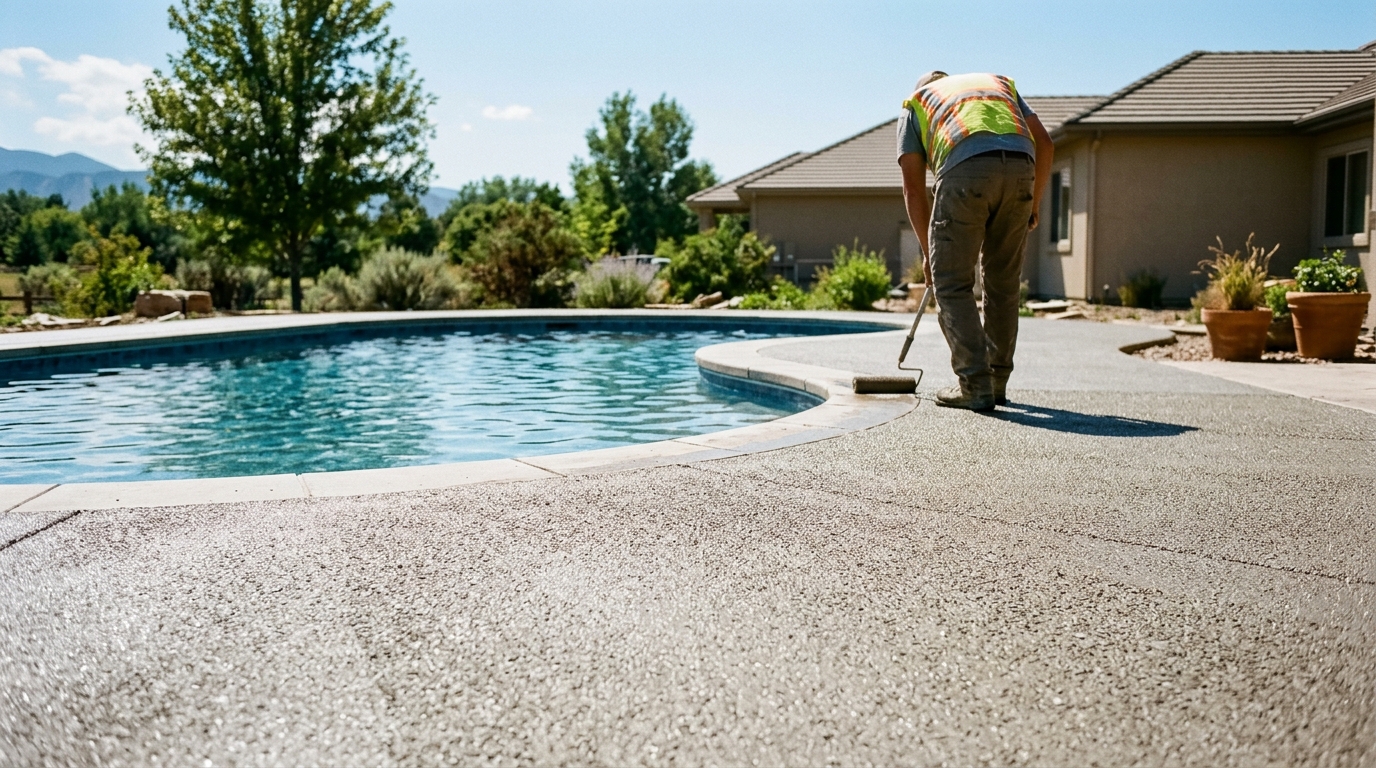
Traction on outdoor walkways is defined by the coefficient of friction, which measures how much grip a surface provides to a moving foot. When concrete is dry, its natural porosity offers excellent slip resistance. However, once water coats the surface, whether from pool splashing, lawn sprinklers, or a sudden afternoon thunderstorm off the foothills, it acts as a lubricant, separating bare skin from the concrete's texture.
To understand how floor safety is evaluated, look at the industry standards. According to the National Floor Safety Institute's ANSI/NFSI standards, walking surfaces require specific dynamic and static coefficient of friction thresholds to be classified as high-traction or slip-resistant under wet conditions—though requirements vary by municipality, so confirm with your local building department. For commercial settings, a wet dynamic coefficient of friction of 0.42 or higher is the standard benchmark for safety—though requirements vary by municipality, so confirm with your local building department. For residential pool decks, achieving this level of safety requires applying deliberate mechanical or chemical textures during the concrete pouring and finishing process. Smooth-troweled concrete should never be used around water because it becomes dangerously slick when wet, leading to an elevated risk of painful falls.
5 Popular Slip-Resistant Finishes for Fort Collins Pool Decks
Every homeowner has different priorities, ranging from strict budget limits to specific aesthetic styles. Fortunately, concrete is highly versatile, allowing for several unique finishes that maximize safety while keeping bare feet comfortable.
1. Traditional Broom Finish
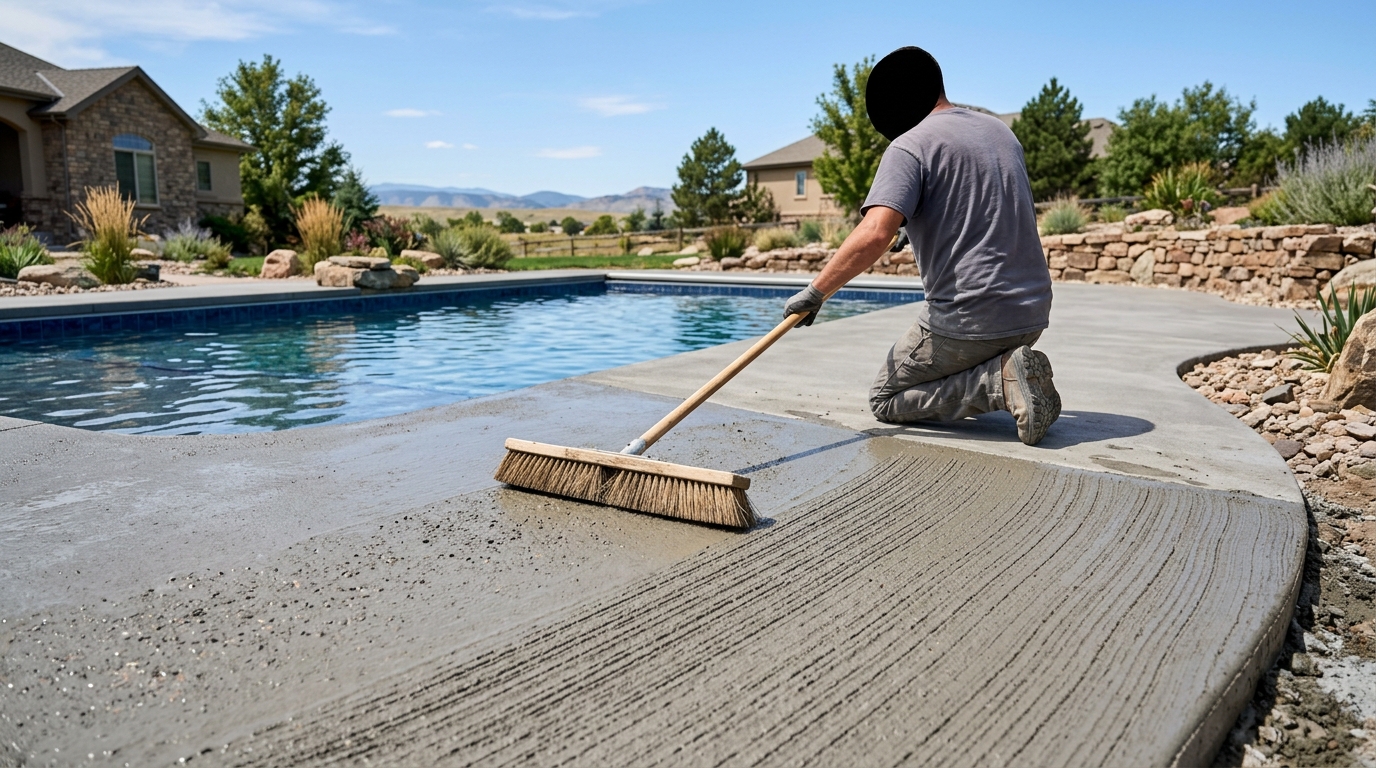
A broom finish is the most widely used and budget-friendly concrete finish for pool decks. After the concrete is poured, leveled, and floated, a craftsman drags a specialized broom across the damp surface. This process leaves behind a series of fine, parallel ridges. The depth of these ridges can be adjusted based on the bristles used, ranging from a fine, soft broom finish to a coarser texture.
This finish provides outstanding traction under wet conditions. However, a coarse broom finish can sometimes feel slightly abrasive on soft, bare feet, especially for children who spend hours in the water. To avoid this, a professional finisher can use a soft horsehair broom, which provides reliable grip without creating sharp, uncomfortable peaks on the surface.
2. The Classic Salt Finish
A salt finish offers a beautiful, rustic appearance that closely mimics the texture of natural weathered stone. To create this look, we broadcast coarse rock salt crystals across the freshly placed concrete and press them lightly into the surface with a float. Once the concrete has set, the surface is washed thoroughly to dissolve and rinse away the salt. This process leaves behind small, shallow indentations.
The resulting pitted texture is excellent at breaking up water tension, significantly reducing the risk of slips. Because the surface is not uniformly flat, water drains more easily, and the surface remains cooler to the touch under the direct Colorado sun. A salt finish is best suited for poured-in-place concrete and provides a subtle, natural aesthetic that blends perfectly with backyard landscaping.
3. Textured Stamped Concrete with Safety Grit
For homeowners seeking the elegant look of natural flagstone, slate, or brick, choosing textured Stamped Concrete in Fort Collins is an exceptional choice. This process involves pressing large polyurethane stamps into wet concrete to imprint deep, realistic patterns.
While stamped concrete looks great, the stamping process compresses the surface, and glossy protective sealers can make it slick when wet. To overcome this hazard, we never apply a standard smooth sealer around a pool. Instead, we blend a specialized polymer or silica-based grit additive directly into the liquid sealer before application. This additive creates a microscopic, slip-resistant profile that locks in the traction without clouding the color or beauty of the pattern.
4. Exposed Aggregate Finish
Exposed aggregate is a highly durable and visually striking choice for pool surrounds. This technique involves removing the very top layer of cement paste from the concrete slab before it fully cures, revealing the decorative stones, pebbles, or sand mixed within.
For pool decks, we specifically select small, rounded river pebbles rather than crushed, jagged gravel. The rounded pebbles provide a textured surface that offers immense grip underfoot while acting as a gentle massager for bare feet. Exposed aggregate is virtually immune to wear and tear, making it one of the longest-lasting non-slip finishes available.
5. Acrylic Spray Knockdown
An acrylic spray knockdown finish involves spraying a polymer-modified acrylic-cement mixture over a cured concrete base. Before the sprayed mixture dries, a trowel is run lightly over the surface to flatten the peaks, leaving a textured, low-relief pattern.
This finish is highly popular because it remains remarkably cool, even during the hottest summer days. The textured pattern offers reliable slip resistance, and the acrylic coating can be tinted to match almost any outdoor color scheme. While highly comfortable and safe, this topping is a separate layer mechanically bonded to your concrete, which means it may eventually require re-coating or maintenance to prevent peeling or wearing down.
The Northern Colorado Climate: Freeze-Thaw Durability and Safety
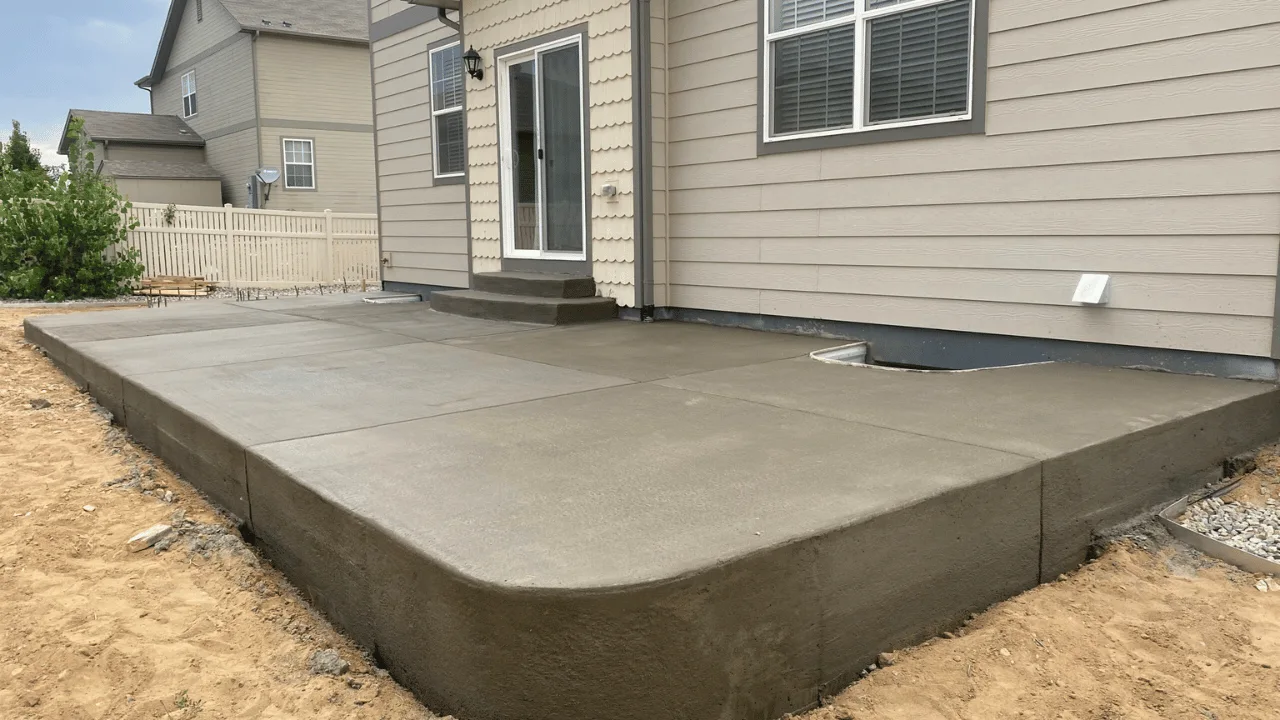
Fort Collins sits at an elevation of over 5,000 feet, exposing our outdoor structures to some of the most demanding weather conditions in the country. We experience intense high-altitude ultraviolet radiation during the summer and severe freezing temperatures in the winter. This environment plays a massive role in how concrete pool decks age and perform.
Our region undergoes frequent freeze-thaw cycles, especially in the late winter and early spring. During these cycles, water from melting snow or pool splash-out gets absorbed into the porous concrete. When the temperature drops overnight, that trapped water freezes and expands. If the concrete is of low quality or lacks proper air-entrainment, this expansion causes the surface to flake, spall, or crack.
When concrete spalls, it destroys the non-slip texture you worked hard to build, creating an uneven surface that is both unsightly and unsafe for bare feet. To protect your investment, we use high-strength, air-entrained concrete mixes specifically formulated for the Front Range climate. These mixes contain billions of microscopic air bubbles that give freezing water room to expand without breaking the concrete apart. Applying a breathable, deep-penetrating sealer protects the deck from water absorption while allowing internal moisture vapor to escape safely.
The Essential Role of Sealers and Non-Slip Additives
Many homeowners do not realize that sealing is the single most important maintenance step for a pool deck. A premium sealer blocks water, protects against chlorine and salt-water splash-out, and prevents chemical erosion. However, applying a standard sealer without proper planning can make even a textured pool deck dangerous.
Glossy, film-forming sealers create a smooth, plastic-like barrier on top of the concrete. When water pools on this barrier, it acts like a slip-and-slide. This is why professional installation is so important. We always match the right sealer to your specific pool deck finish and incorporate a non-slip grit additive.
These additives consist of fine, clear polymer spheres or white pumice grit that remains suspended in the sealer as it dries. Once cured, the grit is completely invisible to the naked eye, preserving the rich color of stained or stamped concrete. Underfoot, however, it creates a texture similar to fine sandpaper, ensuring that even a wet, sealed surface provides secure footing. Over time, heavy foot traffic can wear this grit down, which is why we recommend refreshing the sealer and slip-resistant additive every few years to maintain optimal safety.
Why Professional Concrete Installation Beats the DIY Approach
Installing and finishing a concrete pool deck is a highly technical task that leaves zero margin for error. Concrete is a time-sensitive material. Once the mixing truck arrives at your Fort Collins home, the clock is ticking. In our dry, windy, semi-arid climate, the surface of wet concrete can dry out rapidly while the bottom remains wet.
If a DIYer attempts to stamp, broom, or salt-finish concrete at the wrong moment, the results can be disastrous. Finishing too early traps bleed water beneath the surface, leading to weak concrete that will scale and flake within a few seasons. Finishing too late means the concrete has hardened too much to accept a consistent texture, leaving you with a patchy, slick, and uneven deck.
Working with an experienced Pool Decks Fort Collins expert ensures your project is completed with professional precision. Above and Below Concrete brings five years of local experience, an OSHA 30 Certified team, and a deep understanding of local soil conditions and building standards. We help you plan the entire layout, manage drainage requirements, and select the perfect non-slip finish that matches your budget and lifestyle. Our family owned and operated business stands behind our work with a 100% Satisfaction Guarantee, so your new pool surround is built to last.
Schedule Your Pool Deck Consultation Today
A slip-resistant concrete pool deck keeps your family safe while maintaining a clean look. Regardless of your preference for the classic utility of a soft horsehair broom finish, the natural organic look of a salt finish, or the high-end appeal of stamped stone patterns, proper planning and skilled execution are key to long-term success.
Our team at Above and Below Concrete is here to help you choose the concrete mixes and slip-resistant finishes that work best for your home. We are fully bonded and insured, and we bring a meticulous eye for detail to every project we undertake. Contact us today to discuss your vision, ask questions, or request a quote for your Fort Collins pool deck project. Let us build a safe, slip-resistant surface that stands up to the Colorado elements and keeps your family safe all summer long.
Common Questions
Frequently Asked Questions
Ready To Start?
Get Your Free Quote Today
Get a free quote from Above and Below Concrete — serving Fort Collins and surrounding areas.