How Thick Should a Concrete Driveway Be in Fort Collins?
Learn why expansive soil and heavy vehicles dictate the thickness of your Fort Collins driveway.
The Short Answer
In Fort Collins, a standard residential concrete driveway should be at least four inches thick. However, because Northern Colorado has expansive clay soils and aggressive freeze-thaw cycles, a five-inch or six-inch slab reinforced with rebar is often recommended. If you plan to park heavy trucks or RVs, upgrading beyond the four-inch minimum is essential to prevent the concrete from cracking under the concentrated load.
Every spring in Northern Colorado, homeowners walk outside to find new cracks spiderwebbing across their exterior flatwork. The culprit usually isn't the weight of the snow or the scraping of a shovel. The real damage comes from the ground shifting underneath. When you pour concrete in this region, you are building directly over expansive clay that heaves every time it absorbs moisture and freezes. While a standard baseline pour might pass an initial visual inspection, building a surface that actually survives a decade of our climate takes a bit more intention.
The Four-Inch Baseline Versus Local Reality
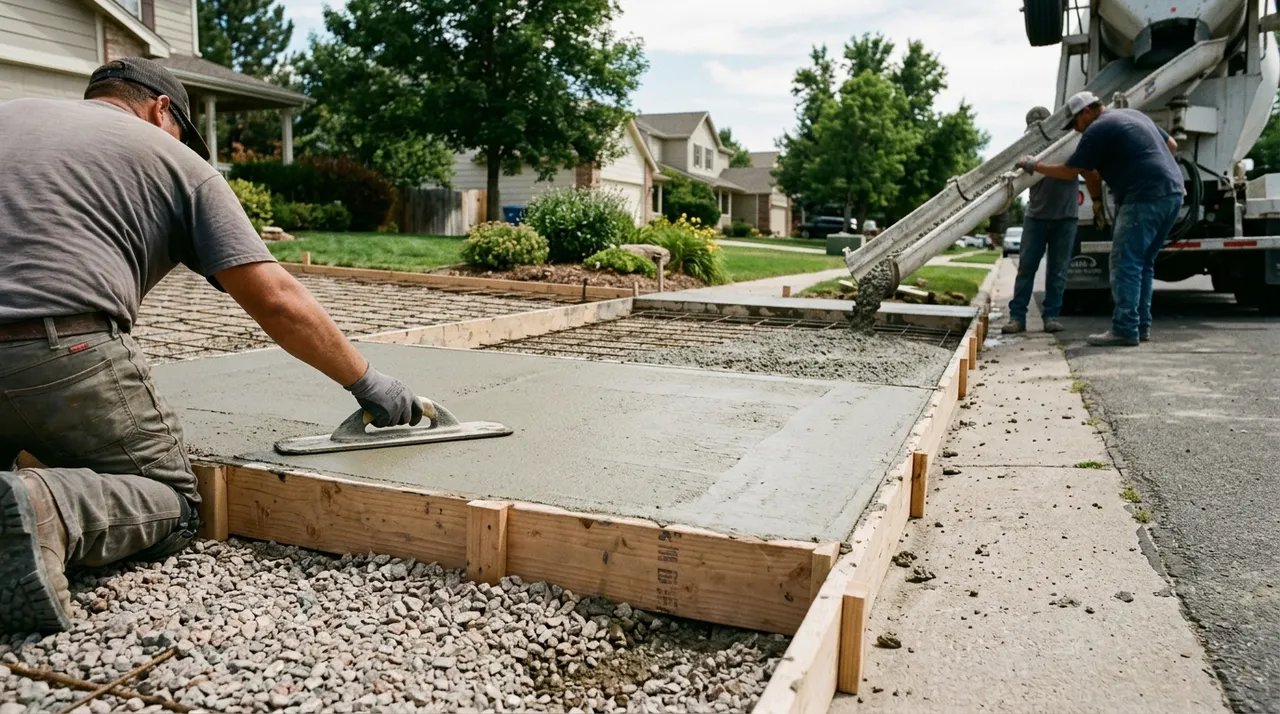
The standard residential pour across most of the United States is four inches. For a typical passenger car sitting on stable, sandy soil, four inches is entirely adequate. The American Concrete Institute guidelines on residential concrete often point to this depth as a reliable baseline for everyday suburban use. However, geography changes the math. What works perfectly in a mild, stable climate often falls short on the Front Range.
According to the Colorado Geological Survey, the soils along our corridor contain a high percentage of expansive clay. When this clay takes on water from spring runoff or heavy summer storms, it swells significantly. When the harsh winter air dries it out, it shrinks and leaves hollow voids beneath the slab. A four-inch slab is the minimum requirement, but the margin for error is incredibly thin. If the subgrade washes out even slightly, a four-inch driveway lacks the structural rigidity to bridge the gap without snapping under the weight of a vehicle. This environmental reality is exactly why the crew at Above and Below Concrete approaches every flatwork project with the local soil conditions in mind.
When to Upgrade to Five or Six Inches
Moving from a four-inch pour to a five-inch pour does not just add twenty-five percent more material. It actually increases the load-bearing capacity of the slab by nearly fifty percent. For homeowners who park standard sedans or lightweight crossovers, four inches on top of a properly compacted base will usually do the job. If you drive heavy-duty diesel trucks, park a loaded utility trailer, or store a recreational vehicle on the side of the house, five inches is the smart starting point.
A six-inch slab is generally reserved for heavy agricultural equipment or commercial delivery zones. Some homeowners still opt for it if they have notoriously bad soil or a severely sloped driveway that takes heavy braking force from large vehicles. The heavier the vehicle, the more downward pressure is transferred through the tires into the concrete. Thicker slabs spread that pressure over a wider footprint, preventing the concentrated load from punching through the surface. This engineered approach to weight distribution is why property owners often request a heavy-duty driveway installation in Fort Collins rather than settling for a basic builder-grade replacement.
The Role of Reinforcement and Base Preparation
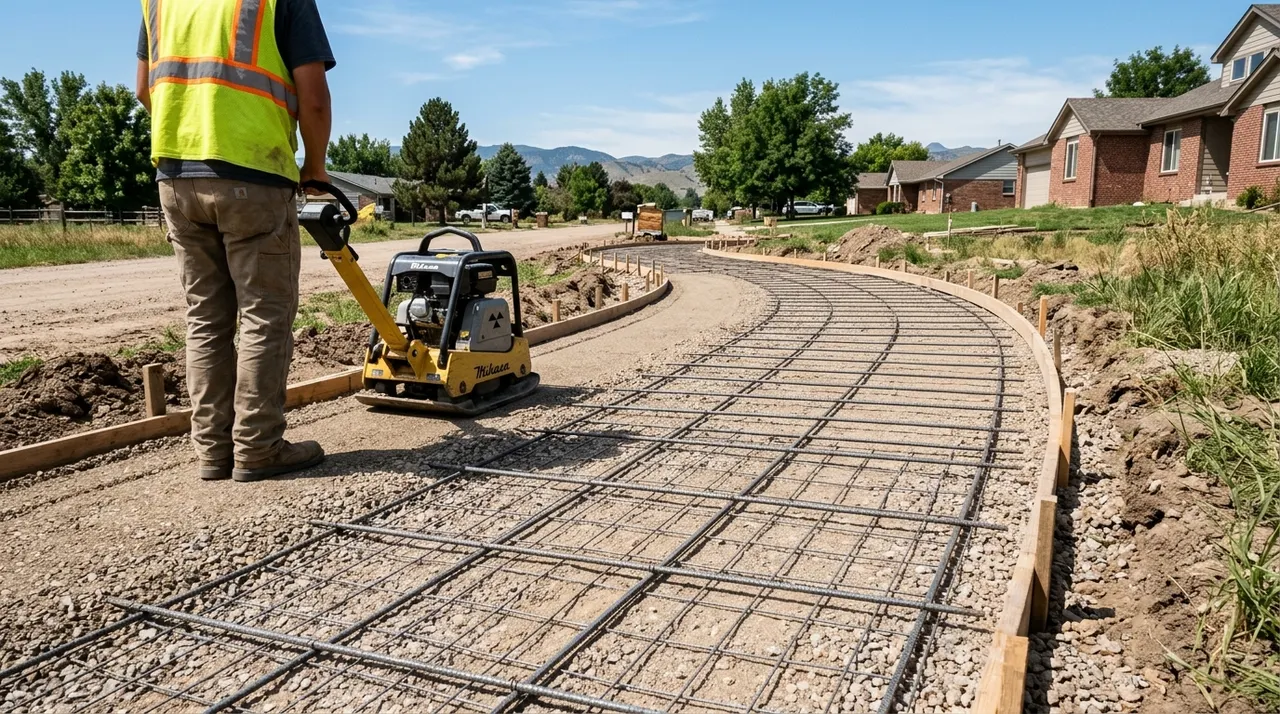
Concrete is incredibly strong against compression, but it is relatively weak against tension. When the ground underneath heaves upward, it bends the slab. To prevent the slab from pulling apart, contractors embed steel inside the concrete. A common industry practice for four-inch slabs is the use of welded wire mesh. The glaring problem with wire mesh is that it frequently gets trampled to the bottom of the wet concrete during the pour, rendering it entirely useless.
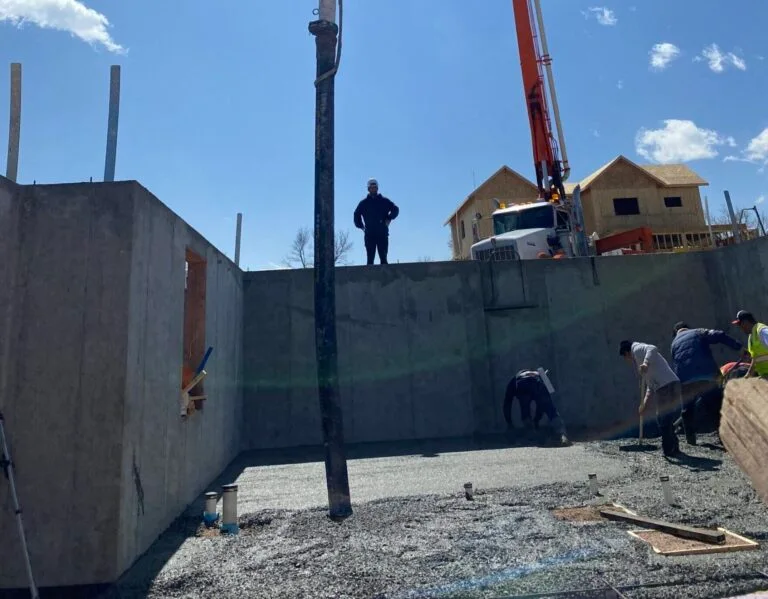
By upgrading to a five-inch pour, a contractor gains the physical space to properly suspend half-inch steel rebar directly in the center of the slab using plastic chairs. A centered rebar grid holds the slab together tightly even if the earth below it shifts. But steel and thickness mean very little if the base preparation is ignored. The standard procedure for a high-quality job involves excavating the organic topsoil and clay, then installing four to six inches of crushed gravel or road base. This aggregate layer must be mechanically compacted with a heavy plate compactor to create a hard, unyielding shelf. The gravel also provides a drainage layer, allowing water to move under the driveway without turning the soil into mud.
Managing Water and Drainage
Water management is the secret to making any flatwork last. If gutter downspouts dump water right next to the driveway, that water saturates the clay base. The clay expands and lifts the slab out of place. Good contractors pay obsessive attention to the grade. The surface must slope away from the house and the garage, typically dropping a quarter of an inch for every foot of distance. This ensures that rainfall and melting snow run off rapidly into the street or yard.
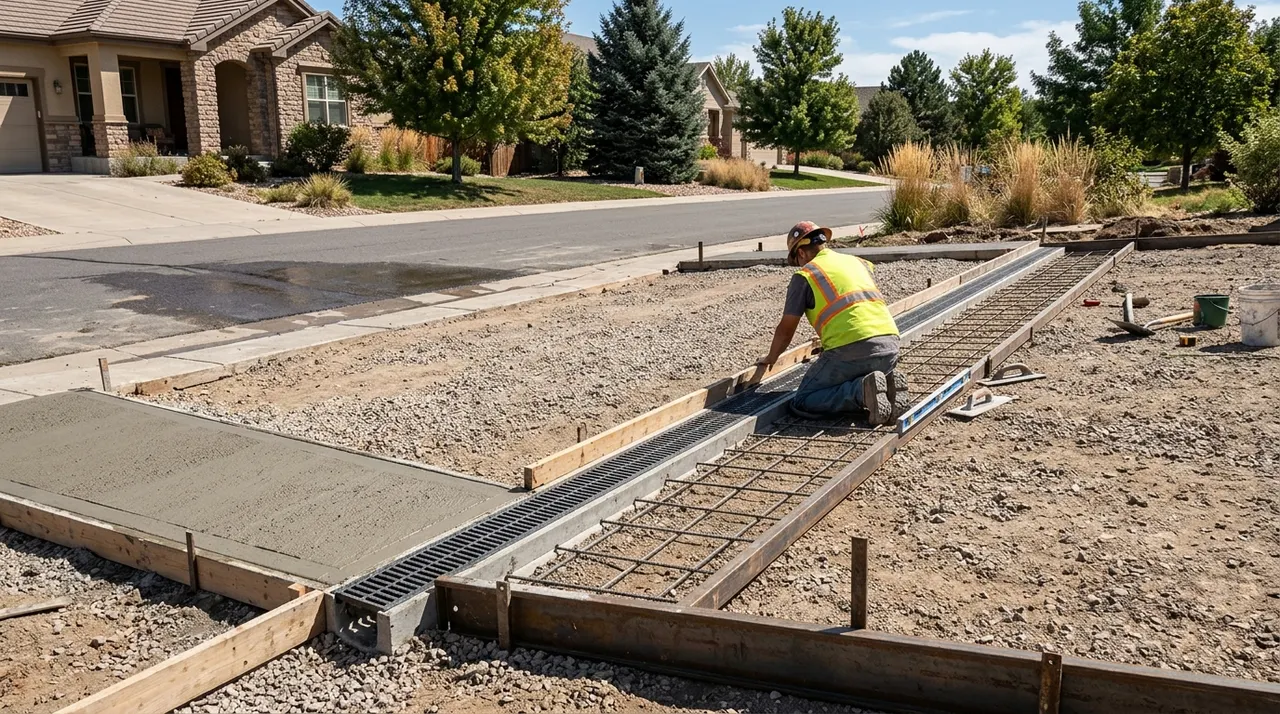
If a driveway sits lower than the surrounding yard, French drains or trench drains must be installed to capture the runoff before it undermines the subgrade. You simply cannot expect a concrete slab to survive if it acts as a dam for your lawn's drainage. Addressing these grading issues during the excavation phase is far cheaper than tearing out a heaved slab three years later.
Surviving the Freeze-Thaw Cycle
Fort Collins experiences aggressive temperature swings. We regularly see sixty degrees and sunshine on a Tuesday followed by single-digit temperatures and a blizzard on Thursday. This extreme freeze-thaw cycle is brutal on flatwork. When water seeps into the microscopic pores of the concrete and freezes, it expands by about nine percent. This internal pressure is what causes the top layer of older driveways to flake or spall off.
To combat this, the concrete mix must be air-entrained. Air entrainment involves adding a chemical to the wet concrete at the batch plant, which creates billions of microscopic air bubbles inside the mixture. These bubbles act as tiny pressure relief valves, giving the freezing water room to expand without blowing apart the surface of the slab. Proper curing also plays a massive role in weather resistance. In the arid Colorado air, moisture can evaporate from a fresh pour far too quickly, leading to a weak, powdery surface. A professional crew will apply a curing compound or use wet curing methods to slow down the evaporation process, allowing the concrete to reach its full designed strength.
Control Joints and Crack Prevention
A harsh truth about concrete is that it is guaranteed to crack. As the mixture cures and hardens, it shrinks. The goal of a competent tradesperson is not to prevent cracking entirely, but to dictate exactly where the cracks happen. This is achieved by cutting control joints into the surface.
To be effective, a control joint must be cut to a depth equal to one-quarter of the total slab thickness. For a standard four-inch driveway, the cuts must be at least one inch deep. For a six-inch driveway, the cuts need to reach an inch and a half down. If the cuts are too shallow, the concrete will ignore them and crack erratically across the surface. Spacing is just as important. A common rule of thumb is to space the joints no further apart than two to three times the thickness of the slab in inches, converted to feet. A five-inch slab should have joints spaced roughly ten to fifteen feet apart to maintain structural integrity.
Understanding Municipal Rules
Before any digging begins, you have to know the local rules. According to the City of Fort Collins building permit guidelines, general residential flatwork on private property is often exempt from requiring a formal building permit. However, the city explicitly notes that permit-exempt does not mean code-exempt. Your project still needs to meet municipal standards for setbacks and drainage, though requirements vary by municipality, so confirm with your local building department before relying on this.
The rules change quickly if your project crosses into the city right-of-way. Replacing the apron where your driveway meets the street, or altering the public sidewalk that cuts through your property, requires a right-of-way permit—though requirements vary by municipality, so confirm with your local building department. The city also mandates the use of specific, approved concrete mix designs for any work touching their infrastructure. Meeting these requirements keeps the job compliant and prevents costly tear-outs ordered by city inspectors.
What Really Drives Replacement Costs?
Cost is usually the deciding factor for any home improvement project. Recent market data from HomeAdvisor shows that the national average for concrete driveway installation ranges from $8 to $20 per square foot. Angi places standard replacements anywhere between $6,400 and $14,500 depending on the total scope. But national averages rarely reflect the reality of building in Larimer County, and your actual cost depends on your specific property. Reach out to us for an estimate to get accurate numbers for your project.
What you actually pay depends on several heavy variables. The first is demolition. Breaking up an old, failed driveway and hauling it to a recycling facility involves heavy machinery and expensive disposal fees. The second variable is base preparation. If your existing soil is mostly soft clay, a significant amount of dirt has to be excavated and replaced with imported structural gravel. The third factor is the material itself. Moving from a four-inch pour to a six-inch pour obviously increases the volume of concrete required from the batch plant, and adding a dense rebar grid increases the steel costs.
Because every single property has a different slope, a different soil profile, and different access constraints, providing a flat rate online is just a guess. A physical site inspection determines exactly what your land requires to support a heavy slab.
Making the Right Decision for Your Property
Deciding how thick to pour your driveway comes down to a realistic assessment of how you use your property. If you have a relatively flat driveway, stable soil, and only park lightweight sedans, a standard four-inch pour on a good gravel base is a perfectly sound investment. If you own heavier vehicles, battle aggressive drainage issues, or want the longest possible lifespan for your flatwork, paying for five inches of concrete and a proper rebar grid is the clear choice.
At Above and Below Concrete, our crew has spent years working in these exact Front Range soil conditions. We are bonded and insured, and OSHA 30 certified to ensure safe, reliable operations on every job site. We back our work with a 100% satisfaction guarantee, and we don't consider the job finished until you are completely happy with the result. We build driveways designed to stand up to the worst weather this region has to offer.
If you need to replace a small parking pad or hire a reliable Fort Collins concrete contractor to pour a massive custom driveway, understanding the process protects your investment. Contact our team today to schedule a site inspection and get an accurate quote for your home.
Common Questions
Frequently Asked Questions
Ready To Start?
Get Your Free Quote Today
Get a free quote from Above and Below Concrete — serving Fort Collins and surrounding areas.